
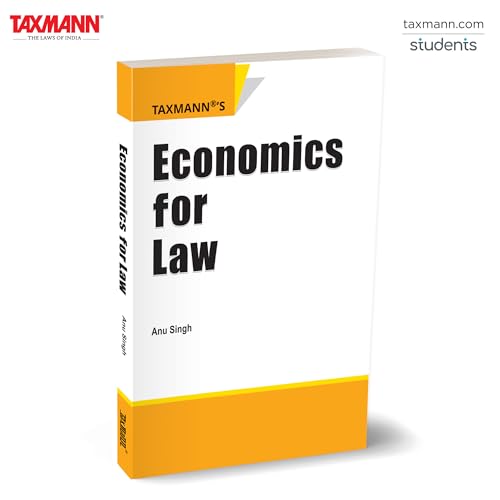
Economics for law
Publication details: New Delhi, Taxmann: 2025.Description: 284p., ind., 24 cm X 15 cmISBN:- 9789371260381
| Item type | Current library | Call number | Status | Barcode | |
|---|---|---|---|---|---|
| Books | KEIC | 340.115 SIN (Browse shelf(Opens below)) | Available | 24047 |
Recommended by: Rasananda Panda
Economics for Law offers a rigorous, law-centred introduction to microeconomic reasoning and demonstrates how economic analysis informs the design, interpretation and enforcement of legal rules. The text is written specifically for law students and focuses on the motivations behind legal rules, the consequences of legal decisions and the efficiency of alternative legal regimes. The author employs economic tools to analyse legal issues and restricts coverage to the concepts that first-year LL.B. students actually need, presenting them in eight carefully selected chapters. To make the material concrete, the book uses practical examples and short 'stories,' showing, for instance, how the Polluter Pays Principle (Pigou) and private bargaining (Coase) map to pollution taxes and out-of-court settlements.This book is intended for the following audience:
LL.B. Students (especially first year) seeking a rigorous yet accessible introduction to economic reasoning in law
Law Teachers & Tutors who want a structured, story-led way to embed economic tools in doctrinal teaching
Policy & Regulatory Professionals (competition/antitrust, consumer, environment) who need a compact microeconomics refresher attuned to legal problems
Early-career Litigators & Transactional Lawyers looking to sharpen arguments with efficiency analysis, incentive design, and evidence from elasticity or market structure.
Contents:
INTRODUCTION TO ECONOMICS FOR LAW
1.1 What is Economics for Law 1
1.2 Meaning and definition 3
1.3 Microeconomics and Macroeconomics 4
1.4 Historical development 6
1.5 Scope of Economics for Law 9
Summary 11
BASIC ECONOMIC CONCEPTS RELEVANT TO LAW
2.1 Introduction 13
2.2 Scarcity, choices and competition 14
2.3 Trade-offs and opportunity costs 15
2.4 Incentives 16
2.5 Rationality and marginality 18
2.6 Exchange creates surplus 21
2.7 Equilibrium and efficiency 27
2.8 Three economic problems and the legal system 33
2.9 Economic Systems 35
I-12 CONTENTS
PAGE
2.10 Economics models 37
Summary 46
3
MARKET MECHANISM
3.1 Market in general 49
3.2 Market in legal context 50
3.3 Demand 50
3.4 Supply 62
3.5 Market equilibrium 70
3.6 Market efficiency 79
Summary 90
4
ELASTICITY OF DEMAND AND SUPPLY
4.1 Elasticity: Definition and meaning 93
4.2 Other types of elasticity of demand 107
4.3 Legal implications of demand elasticity 121
Summary 125
5
CONSUMER CHOICE THEORY
5.1 What and why of consumer choice theory 128
5.2 Utility 130
5.3 Ordinal utility approach 139
5.4 Behavioural economics and consumer choice 156
5.5 Why a law student must understand consumer behaviour?
Summary 161
6
THEORY OF PRODUCTION AND COST
6.1 What is production? 165
6.2 The cost of production 180
6.3 Other concepts of cost 193
6.4 Relevance for lawyers and policymakers 196
Summary 197
7 THEORY OF THE FIRM: HIGHLY COMPETITIVE MARKETS
7.1 Introduction 200
7.2 The theory of the firm 202
7.3 Firm’s behaviour in different market structures 212
7.4 Significance for lawyers 226
Summary 228
8
THEORY OF THE FIRM: HIGHLY CONCENTRATED MARKETS
8.1 Highly concentrated markets 230
8.2 Oligopoly market structure 231
8.3 Monopoly 242
Summary 267
There are no comments on this title.