
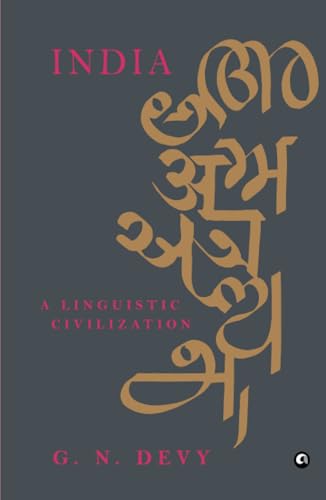
India: a linguistic civilization
Publication details: New Delhi: Aleph Book Company, 2024.Description: 194p., note., bib., 21 cm X 13 cmISBN:- 9789393852670
- 417.7
| Item type | Current library | Call number | Status | Date due | Barcode | |
|---|---|---|---|---|---|---|
| Books | KEIC | 417.7 DEV (Browse shelf(Opens below)) | Checked out to Sanskruti S. Deshpande (20240314004) | 12/14/2025 | 23985 |
Recommended by: Sanskruti Deshpande
Summary: India’s spectacular linguistic diversity is one of its most defining characteristics as a civilization. The complex trajectory of our languages is intertwined with the evolution of the Indian identity, imagination, and intellectual history. Our languages are a repository of human ideas and experiences across millennia and remain at the core of intense deliberations on what constitutes the ‘idea of India’. Yet to map their evolution is a monumental endeavour—the number of languages to have existed and the ones that continue to be in use are far too many to determine a particular point of origin or reconstruct the story in its entirety.
In this path-breaking book, celebrated academic and intellectual G. N. Devy lays bare the mysteries and intricacies of India’s linguistic past, present, and future. The evolution of language is set against the larger historical canvas of human progress, and gives due weight to the influences of migration, agriculture, newer patterns of settlement, formation of religious sects, cultural resistance, and centuries of British colonialization on the shaping of our linguistic heritage. The book also engages with language, identity, and political consciousness, and underscores the significance of collective responsibility in preserving endangered languages of indigenous and marginalized communities. The author studies memory and oral practices as tools of linguistic creativity and as essential components of Indian knowledge and learning systems that have been overshadowed by the written word. And importantly, the book addresses the battle between technological advancement and dialogue and diversity and explores pathways to prevent the loss of both unclassified dialects and minor languages as well as the literary and philosophical traditions of major ones.
Contents:
1. India as a Linguistic Civilization
2. Language and the State
3. Memory and Oral Traditions
4. Digital Future, Translation, and Knowledge
There are no comments on this title.